Health
Understanding BMI: What the Number Means and What It Does Not
April 14, 2025 • 8 min read
BMI is a quick screening number, not a diagnosis. Here is how it is calculated, what the ranges mean, what it cannot capture, and why individual context matters before you draw any conclusions about your health.
How BMI is calculated
Body mass index divides your weight in kilograms by the square of your height in metres. For example, 78 kg at 175 cm gives a BMI of 25.5, because 78 divided by 1.75 squared (3.0625) equals roughly 25.5. Imperial measurements are converted to metric before the calculation, so the same formula works regardless of the units you start with. The calculation is deliberately simple — it uses only height and weight, both of which are easy to measure at home — which is exactly why BMI has become the most widely used screening number in the world. Its simplicity is its strength for population-level screening, but it is also the source of its main limitation: it cannot tell you anything about what your body is made of.
Calculate your BMIThe standard adult ranges
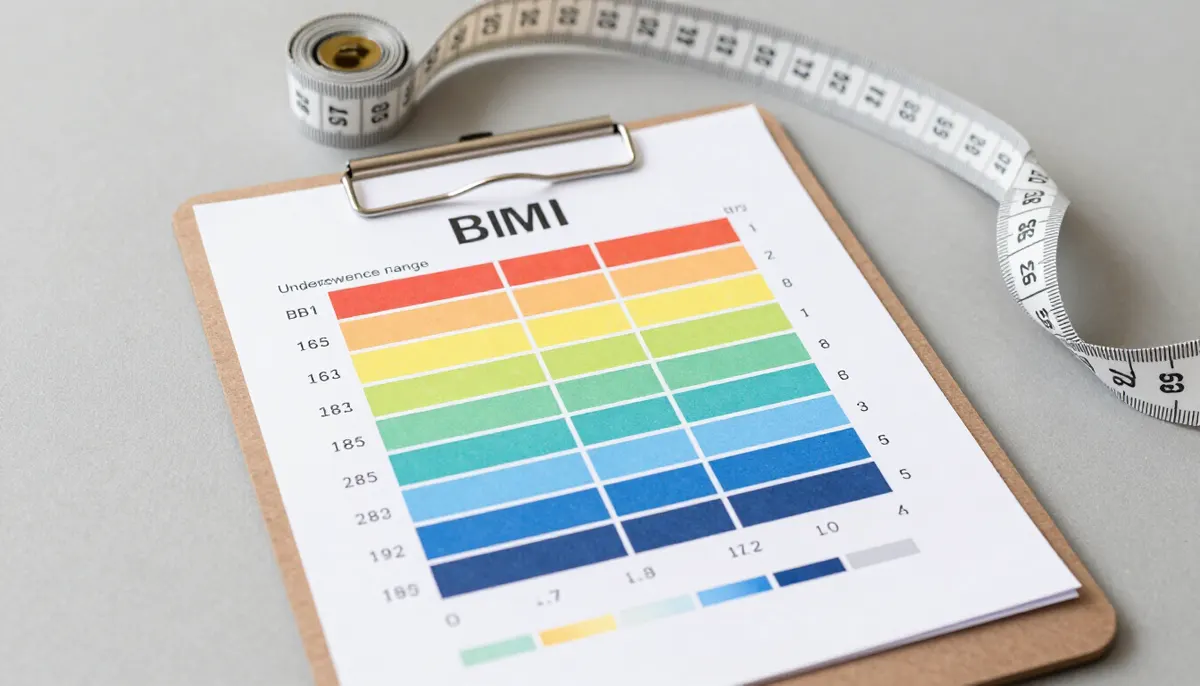
The World Health Organization defines ranges as: under 18.5 underweight; 18.5 to 24.9 healthy weight; 25 to 29.9 overweight; 30 and above obese. These thresholds are designed for population-level screening, not individual assessment — they describe statistical risk across large groups, not a verdict on any one person. A BMI of 26 does not mean an individual is unhealthy, just that on average people in that band carry somewhat higher risk. The ranges are also calibrated primarily on adult populations of European descent, and some health organisations suggest adjusted thresholds for certain ethnic groups, for whom health risk may rise at lower BMI values. Treat the ranges as a prompt to look closer, not as a final answer.
What BMI does not capture
BMI cannot distinguish muscle from fat, and it says nothing about where fat is stored — two factors that matter a great deal for health. An athlete with high muscle mass may register as overweight or obese despite having low body fat, because muscle is denser than fat and the formula cannot tell the difference. Body fat distribution also matters: fat carried around the waist is associated with higher metabolic risk than fat carried on the hips and thighs, yet BMI treats both identically. Age, sex and ethnicity all affect health risk in ways that a single ratio cannot capture, and older adults in particular may have a higher healthy BMI than the standard ranges suggest. In short, BMI is a starting point for a conversation, not the conversation itself.
When to speak to a professional
If your BMI is outside the healthy range, or you have concerns about your weight or health, a GP or registered dietitian can assess you properly using additional measures such as waist circumference, blood pressure, blood tests and a discussion of your lifestyle and family history. A professional interprets the number in context rather than in isolation, which is the only way to use it well. This is especially important if you are considering significant changes to your diet or activity based on a BMI result, because a number alone cannot tell you whether those changes are appropriate or safe for your situation. The right response to an unexpected BMI is curiosity followed by a conversation, not alarm followed by a crash diet.

How to measure accurately
For a BMI calculation to be meaningful, the inputs need to be accurate. Measure your height without shoes, standing straight against a wall, ideally first thing in the morning when your spine is fully extended. Weigh yourself at a consistent time of day — morning, after using the bathroom and before eating — because weight fluctuates by a kilogram or more through a normal day due to hydration, food and activity. Use the same scale each time, and do not read too much into a single reading; track the trend over weeks rather than day-to-day changes. Small measurement errors have only a small effect on BMI, but inconsistent measurements make the number jump around for no real reason.
BMI for children and teenagers
The adult BMI ranges do not apply to children and teenagers, whose body composition changes as they grow. For under-18s, BMI is plotted on age- and sex-specific growth charts and expressed as a percentile rather than a fixed category, because a healthy BMI at age eight is very different from a healthy BMI at sixteen. If you are concerned about a child weight, speak to a health professional who can interpret the growth chart correctly rather than applying adult thresholds, which would give misleading results. Never put a child on a restrictive diet based on a BMI number without professional guidance.
Alternatives to BMI
Because BMI has clear limitations, researchers and clinicians use additional measures alongside it. Waist circumference is a simple one that captures abdominal fat, the type most strongly linked to metabolic risk. Waist-to-height ratio — keeping your waist circumference below half your height — is another accessible rule of thumb that often predicts health risk better than BMI alone. Body fat percentage, measured by callipers or bioelectrical scales, gives a more direct picture of composition but is harder to measure accurately at home. None of these replaces BMI entirely; together they give a fuller view than any single number can.
Common mistakes interpreting BMI
Treating a single BMI reading as a diagnosis rather than a screening prompt; ignoring muscle mass and fat distribution, which BMI cannot see; comparing your BMI to a friend without accounting for differences in build, age and sex; and reacting to a result with drastic changes rather than a measured conversation with a professional. Another common mistake is weighing yourself too often and reading meaning into normal daily fluctuations, which can make a stable BMI feel unstable.
Using BMI alongside other numbers
No single number tells the whole story of your health, so the best use of BMI is alongside a few other simple measures rather than in isolation. Track your waist circumference, your blood pressure if you have a monitor, and how you feel during normal activity — each captures something BMI cannot. Watching the trend across several measures over months is far more informative than any one reading, because it smooths out the noise of daily fluctuation and shows the direction your health is actually moving. A small notebook or a simple app is enough; the value is in the habit of looking at the whole picture, not in any single figure.
Setting realistic expectations
If you are using BMI to guide a change in weight, set realistic expectations about how quickly that change happens. Healthy, sustainable weight change is usually measured in small amounts per month, not large amounts per week, and BMI shifts slowly because it depends on both weight and the unchanging height. Focus on consistent habits rather than chasing a specific number, and recheck your BMI every few weeks rather than daily, when normal fluctuation can make progress look like stagnation. If the number is not moving in the direction you expect after a reasonable period, that is a signal to review your approach with a professional rather than to push harder on your own.
Frequently asked questions
Is BMI accurate for athletes? Not really — high muscle mass can push a lean athlete into the overweight range, so BMI is a poor fit for very muscular people. Does BMI measure fitness? No, it measures weight relative to height and says nothing about cardiovascular fitness, strength or flexibility. Can BMI tell me my body fat percentage? No, it only estimates from weight and height; a direct body fat measurement is needed for that. Should I check my BMI often? A few times a year is enough for most adults; more frequent checks mainly capture normal weight fluctuation. Is a high BMI always unhealthy? Not necessarily — context matters, which is why a professional assessment is the right next step rather than self-diagnosis.
Related Tools
Try these FillAtlas tools alongside this guide.